
Overview
The Corinth Canal is a waterway that crosses the narrow isthmus of Corinth to link the Gulf of Corinth to the Saronic Gulf. As such, the canal separates the Greek mainland from the Peloponnese, turning it into an island
Mycenae
‘Rich in Gold', the kingdom of mythical Agamemnon, first sung by Homer in his epics, is the most important and richest palatial centre of the Late Bronze Age in Greece. Its name was given to one of the greatest civilizations of Greek prehistory, the Mycenaean.
Capturing all the spirit of the Olympic Games, it’s also the place where the Olympic flame is lit in commemoration of the Games that originated and were held here every four years for a staggering 1,000 years.
Located in the western Peloponnese, Ancient Olympia was one of the most sacred and glorious sanctuaries of the ancient world. And, though only foundations of many of its structures remain, it is still one of the most evocative of Greece’s archaeological sites
- Recommended by 98% of travelers
- Badge of Excellence
- Free cancellation up to 24 hours before
- Mobile ticket
What's included
Pick-up and drop-off service: Athens Hotel, Airbnb residence or Port
Car Seats: Book in advance if you require infant or child seats.
Transportation via modern, private vehicle
Lunch
Breakfast
All vehicles with WiFi, A/C, Bottled Water
Fully Private Tour
English-speaking tour driver well-versed in Greek history. (Not licensed to accompany in any site
Lunch, other beverages and meals.
Overnight Hotels in any City we visit
Entrance fees for all the attractions is optional
Tips and gratuities
Food & Drinks
Meeting and pickup
Pickup is offered for all travelers.
What to expect
Day 1 Isthmus Canal Ancient Corinth Mycenae Epidavrous Nafplio
-
Corinth Canal
20 min Admission ticket included
The Corinth Canal is a waterway that crosses the narrow isthmus of Corinth to link the Gulf of Corinth to the Saronic Gulf. As such, the canal separates the Greek mainland from the Peloponnese, turning it into an island
The canal, though executed in the late 19th century, has been a 2000-year-old dream. Before its construction, ships in the Aegean Sea that wanted to cross to the Adriatic or anchor in Corinth, a rich shipping city, had to circle the Peloponnese, which would prolong their journey an extra 185 nautical miles.
It is believed that Periander, the tyrant of Corinth (602 BC), was the first to conceive of the idea of digging the Corinth Canal. As the project was too complicated given the limited technical capabilities of the times, Periander constructed the diolkos, a stone road which allowed ships to be transferred on wheeled platforms. -
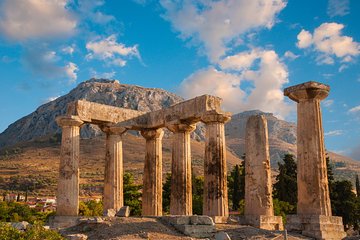
Ancient Corinth (Archaia Korinthos)
1 hour Admission ticket not included
Corinth was a city-state on the Isthmus of Corinth, the narrow stretch of land that joins the Peloponnese to the mainland of Greece, roughly halfway between Athens and Sparta. The modern city of Corinth is located approximately 5 kilometres (3.1 mi) northeast of the ancient ruins.
For Christians, Corinth is well known from the two letters of Saint Paul in the New Testament, First and Second Corinthians. Corinth is also mentioned in the Acts of the Apostles as part of Paul the Apostle's missionary travels. In addition, the second book of Pausanias' Description of Greece is devoted to Corinth.
Ancient Corinth was one of the largest and most important cities of Greece, with a population of 90,000 in 400 BC. The Romans demolished Corinth in 146 BC, built a new city in its place in 44 BC, and later made it the provincial capital of Greece. -
Archaeological Museum of Corinth
30 min Admission ticket not included
The Archaeological Museum of Ancient Corinth was constructed between 1931-1932, with intentions to display the numerous recent archaeological excavations. The museum is located within the archaeological site of Ancient Corinth, Greece, and lies under the jurisdiction of the 37th Ephoreia of the Greek Archaeological Service.
Key aspects of the Archaeological site of Ancient Corinth include:
Hadgimoustafa spring
Lechaion Road
Basilica
Fountain of Peirene
Stoa
Agora
Odien
Other temples
Theatre -
30 min Admission ticket included
Acrocorinth, "Upper Corinth", the acropolis of ancient Corinth, is a monolithic rock overseeing the ancient city of Corinth, Greece.
With its secure water supply, Acrocorinth's fortress was repeatedly used as a last line of defense in southern Greece because it commanded the Isthmus of Corinth, repelling foes from entry by land into the Peloponnese peninsula. -
Mycenae
30 min
The fortified citadel of ancient Mycenae, the seat of the mythical and mighty King Agamemnon. An impressive and well-preserved site, the city of Mycenae gave its name to an entire civilization. Admire sites such as the Tomb of Clytemnestra, the infamous Lion’s Gate, the Cyclopean walls and learn of their blood-stained past. In the second millennium BC, Mycenae was one of the major centres of Greek civilization, a military stronghold which dominated much of southern Greece, Crete, the Cyclades and parts of southwest Anatolia. The period of Greek history from about 1600 BC to about 1100 BC is called Mycenaean in reference to Mycenae. At its peak in 1350 BC, the citadel and lower town had a population of 30,000 and an area of 32 hectares.
-
Archaeological Site Mycenae
1 hour Admission ticket not included
The archaeological site of Mycenae comprises the fortified acropolis and surrounding funerary and habitation sites, which are located mainly to its west and southwest. Most of the visible monuments date to the centre's great floruit, from 1350 to 1200 BC.
Great Cyclopean walls surround the almost triangular acropolis, which is accessed from the northwest through the famous Lion Gate, the symbol of the Mycenaean rulers' power. The gate was named after the two opposing lions carved in relief and set into the relieving triangle, a typical feature of Mycenaean architecture, over the door. -
Archaeological Museum of Ancient Mycenae
15 min Admission ticket not included
Rich in Gold', the kingdom of mythical Agamemnon, first sung by Homer in his epics, is the most important and richest palatial centre of the Late Bronze Age in Greece. Its name was given to one of the greatest civilizations of Greek prehistory, the Mycenaean civilization, while the myths related to its history have inspired poets and writers over many centuries
-
Lion Gate
15 min
The Lion Gate was the main entrance of the Bronze Age citadel of Mycenae, southern Greece. It was erected during the 13th century BC, around 1250 BC, in the northwest side of the acropolis and is named after the relief sculpture of two lionesses or lions in a heraldic pose that stands above the entrance.
The Lion Gate is the sole surviving monumental piece of Mycenaean sculpture, as well as the largest sculpture in the prehistoric Aegean. It is the only monument of Bronze Age Greece to bear an iconographic motif that survived without being buried underground, and the only relief image which was described in the literature of classical antiquity, such that it was well known prior to modern archaeology. -
Citadel and Treasury of Atreus
15 min Admission ticket not included
The Treasury of Atreus or Tomb of Agamemnon is a large tholos or beehive tomb on Panagitsa Hill at Mycenae constructed during the Bronze Age around 1250 BC. The stone lintel above the doorway weighs 120 tons, with approximate dimensions 8.3 x 5.2 x 1.2m, the largest in the world. The tomb was used for an unknown period. Mentioned by the Roman geographer Pausanias in the 2nd century AD, it was still visible in 1879 when the German archaeologist Heinrich Schliemann discovered the shaft graves under the "agora" in the Acropolis at Mycenae.
-
The Ancient Theatre of Epidaurus
1 hour Admission ticket not included
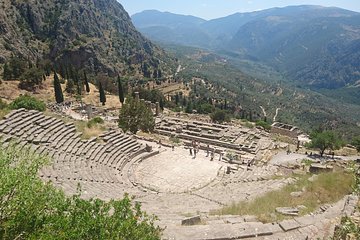
The Epidaurus amphitheatre: Famous for its classic Greek construction and astounding acoustics. Enjoy the arts! Be captivated by the theatrical performances from Euripides, Sophocles, Aristophanes and Aeschylus. Drop a pin or coin on the stage... it will be heard even if you are sitting at the last seats of the theater.
The Epidaurus Archaeological Museum: Noted for its reconstructions of temples and its columns with inscriptions.
The Asclepius: The sanctuary dedicated to the ancient Greek demi-god of medicine Asclepius. A marvelous ancient medical retreat.The Ancient Theatre of Epidaurus is a theatre in the Greek city of Epidaurus, located on the southeast end of the sanctuary dedicated to the ancient Greek God of medicine, Asclepius. It is built on the west side of Cynortion Mountain, near modern Lygourio, and belongs to the Epidaurus Municipality. It is considered to be the most perfect ancient Greek theatre with regard to acoustics and aesthetics. -
Sanctuary of Asklepios
15 min Admission ticket not included
The Temple of Asclepius was a sanctuary in Epidaurus dedicated to Asclepius. It was the main holy site of Asclepius. The sanctuary at Epidaurus was the rival of such major cult sites as the Sanctuary of Zeus at Olympia and Apollo at Delphi. The temple was built in the early 4th century BC. If still in use by the 4th century AD, the temple would have been closed during the persecution of pagans in the late Roman Empire, when the Christian Emperors issued edicts prohibiting non-Christian worship.
-
Epidaurus Archaeological Museum
15 min Admission ticket not included
The Temple of Asclepius was a sanctuary in Epidaurus dedicated to Asclepius. It was the main holy site of Asclepius. The sanctuary at Epidaurus was the rival of such major cult sites as the Sanctuary of Zeus at Olympia and Apollo at Delphi. The temple was built in the early 4th century BC. If still in use by the 4th century AD, the temple would have been closed during the persecution of pagans in the late Roman Empire, when the Christian Emperors issued edicts prohibiting non-Christian worship.
-
Nafplio
1 hour
Free Time For Lunch Coffe Shopping
Nafplio is a seaport town in the peloponnese in Greece that was expanded up the hillsides near the north end of the Argolic Gulf.The town was an important seaport held under a successsional of royal houses in the middle Ages as a part of the loardship of ARGOS and NAUPLIA .The town was the capital of the First HELLENIC republic and of the kingdom of Greece from the start of the Greek Revolution
The Lion of the Bavarians
It's impressive, it's huge, it's carved into the rock above Michael Iatrou Street, with a small park under its feet. The sleeping lion is the work of German sculptor Christian Ziegel, commissioned by King Louis, father of Otto, in memory of the Bavarian soldiers of Otto's dynasty, who died in Nafplio in 1833 of a typhoid epidemic. The locals, of course, say that what killed them was the many bitter things they ate, hence the other, unofficial name of the monument (echm) Agouroon. -
Palamidi Castle
30 min Admission ticket not included
One of the most well-preserved castles in all of Greece, Palamidi offers spectacular views of the city from its loopholes, wonderful routes inside and terrifying terrain in the hole-prison of Kolokotronis,
Palamidi is a fortress to the east of the Acronauplia in the town of Nafplio in the Peloponnese region of southern Greece. Nestled on the crest of a 216-metre high hill, the fortress was built by the Venetians during their second occupation of the area (1686–1715).
The fortress commands an impressive view over the Argolic Gulf, the city of Náfplio and the surrounding country. There are 913 steps in the winding stair from the town to the fortress. However, to reach the top of the fortress there are over one thousand, while locals in the town of Nafplion will say there are 999 steps to the top of the castle. -
Bourtzi
40 min Admission ticket not included
Enjoy the view of the water castle of Bourtzi a Venetian Castle located in the middle of the harbor of Nafplio and take fascinating photos from the Harbor side
Day 2 Ancient Olympia
-
20 min Admission ticket not included
The remains of the only circular building on the site once contained gold-and-ivory-covered statues of Philip of Macedon and his family, including his son Alexander the Great. It was built by Philip to commemorate a victory against a combined army of Athenians and Thebans.
-
Archaeological Site of Olympia
2 hours Admission ticket not included
The Ancient Stadium and Archway
Passing through a stone archway, you enter the remains of the Ancient Stadium, once housing more than 45,000 spectators. The mind boggles at being able to line up on the track (measuring 192.27m), just as the finest athletes in the land did thousands of years ago. Nearby are the judge’s seats. On your marks, get set…
The Palaestra
Built in the 3rd century BC, the partly restored Palaestra was where contestants prepared for boxing, wrestling and jumping events.
Pheidias’ Workshop
This is where the legendary sculptor Pheidias created one of his most famous pieces of work – the gargantuan ivory-and-gold statue of Zeus, which became one of the Seven Wonders of the Ancient World.
The Temple of Zeus
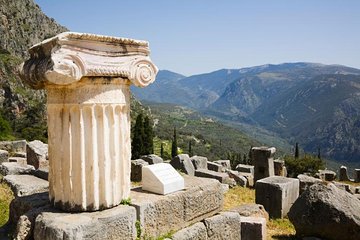
The most important building of the Altis (or Sacred Precinct of Zeus) was the immense 5th-century-BC Doric temple dedicated to the king of the gods. It housed Pheidias’ statue of Zeus for more than 800 years. One column of the temple has been restored, allowing -
Archaeological Museum of Olympia
45 min Admission ticket not included
The Archeological Museum of Olympia: Exhibits incredible artifacts from the site.
Statue of Zeus: A giant seated figure about 13 m tall. The huge ivory and gold statue was bigger even than that of Athena in the Parthenon.
The Museum of the History of the Olympic Games in Antiquity: Since 2004 a new museum is in operation. The museum was based on the collection of Georgios Papastefanou who was the first to believe in the possibility of spreading the Olympic Idea and Education through a museum.
The museum of Archimedes (Mathematician) regarded as one of the leading scientists in classical antiquity. A unique museum in the center of ancient Olympia dedicated to the "Greatest Mind" of all time. Visitors will have the opportunity to see replicas of his inventions and to interact with them. -
Museum of the Olympic Games
30 min Admission ticket not included
The Museum of the History of the Olympic Games in Antiquity: Since 2004 a new museum is in operation. The museum was based on the collection of Georgios Papastefanou who was the first to believe in the possibility of spreading the Olympic Idea and Education through a museum.
The museum of Archimedes (Mathematician) regarded as one of the leading scientists in classical antiquity. A unique museum in the center of ancient Olympia dedicated to the "Greatest Mind" of all time. Visitors will have the opportunity to see replicas of his inventions and to interact with them.
Olympia village: In the western Peloponnese, in the beautiful valley of the Alpheios river lies the most celebrated sanctuary of ancient Greece. You will be amazed by the serenic feel that this village creates.
"La Belle Helene meeting wonderful Konstantina enjoying her delicious authentic Greek home cooked meals
Stroll amongst the village shops where you can treat yourself and buy handmade souvenirs for your family. -
Market of Ancient Olympia
20 min Admission ticket not included
The Hippodrome and later Stadium: The Hippodrome was a wide flat open area where the starting and finishing line was defined by a pole. Horse and chariot races took place here.
The Palaestra: Built in the 3rd century BC as part of the gymnasium complex it was used to practice boxing, wrestling and jumping.
The Workshop of Pheidias: This is where the great sculptor crafted the gigantic chryselephantine statue of Zeus listed as one of the Seven Wonders of the ancient world.
The Archeological Museum of Olympia: Exhibits incredible artifacts from the site.
Statue of Zeus: A giant seated figure about 13 m tall. The huge ivory and gold statue was bigger even than that of Athena in the Parthenon. -
20 min
emple of Zeus: Dedicated to the god Zeus the Doric temple built in the second quarter of the 5th century BCE was the very model of the fully developed classical Greek temple of the Doric order.
-
Archimedes Museum
20 min Admission ticket not included
The museum of Archimedes (Mathematician) regarded as one of the leading scientists in classical antiquity. A unique museum in the center of ancient Olympia dedicated to the "Greatest Mind" of all time. Visitors will have the opportunity to see replicas of his inventions and to interact with them.
Day 3 DELPHI Navel Of Earth & Hosios Loukas
-
Mount Parnassus
20 min
Mount Parnassus is a mountain in central Greece that towers above Delphi, north of the Gulf of Corinth.
Mount Parnassus offers many advantages to the population of Greece. In peace, it possesses scenic views of the countryside and features olive groves and rolling hills. The mountain is also the location of historically, archaeologically, and culturally significant places of interest (such as Delphi). Recreationally, the slopes of Parnassus provide a medium for hiking (in the three warm seasons) and are skied in winter. Its melting snows provide water to the surrounding communities, reaching out as far as Athens. The mountain is composed of limestone, and its rock contains bauxite, ore that is rich in aluminum. In war, Parnassus has been a center of resistance if need be, providing cover and refuge to partisans. -
Monastery of Hosios Loukas
30 min Admission ticket included
Hosios Loukas is a historic walled monastery situated near the town of Distomo, in Boeotia, Greece. It is one of the most important monuments of Middle Byzantine architecture and art and has been listed on UNESCO's World Heritage Sites, along with the monasteries of Nea Moni and Daphnion.
The monastery of Hosios Loukas is situated at a scenic site on the slopes of Mount Helicon. It was founded in the early 10th century AD by the hermit, Venerable (Greek: Hosios) Luke of Steiris (Greek: Lukas), whose relics are kept in the monastery to this day.
The main shrine of the monastery is the tomb of St. Luke, originally situated in the vault, but later placed at the juncture of the two churches. The monastery derived its wealth (including funds required for construction) from the fact that the relics of St. Luke were said to have exuded myron, a sort of perfumed oil which produced healing miracles. -
Delphi
1 hour
Arrival at the archaeological site of Delphi after a 2,5 hours trip.
Free time for a walk at:
- sanctuaries of Apollo and Athena Pronaia
- ancient stadium and theater
Duration: 30 minutes -
Tholos of Athena Pronaia
30 min Admission ticket not included
The tholos at the sanctuary of Athena Pronoia (Ἀθηνᾶ Πρόνοια, “Athena of forethought”) is a circular building that was constructed between 380 and 360 BC. It consisted of 20 Doric columns arranged with an exterior diameter of 14.76 meters, with 10 Corinthian columns in the interior.
The Tholos is located approximately a half a mile (800 meters) from the main ruins at Delphi. Three of the Doric columns have now been restored, making it the most popular site at Delphi for tourists to take photographs.
The gymnasium, which is half a mile away from the main sanctuary, was a series of buildings used by the youth of Delphi. The building consisted of two levels: a stoa on the upper level providing open space, and a palaestra, pool and baths on lower floor. These pools and baths were said to have magical powers, and imparted the ability to communicate to Apollo himself. -
Delphi Archaeological Museum
45 min Admission ticket not included
Delphi Archaeological Museum is one of the principal museums of Greece and one of the most visited. It is operated by the Greek Ministry of Culture. Founded in 1903, it has been rearranged several times and houses the discoveries made at the Panhellenic sanctuary of Delphi, which dates from the Late Helladic (Mycenean) period to the early Byzantine era.
Organized in fourteen rooms on two levels, the museum mainly displays statues, including the famous Charioteer of Delphi, architectural elements, like the frieze of the Siphnian Treasury, and ex-votos dedicated to the sanctuary of Pythian Apollo, like the Sphinx of Naxos. The exhibition floor space is more than 2270m2, while the storage and conservation rooms (mosaics, ceramics). Delphi’s magnificent modern museum, 500m east of town, perfectly complements the ancient site alongside. Which you visit first doesn’t matter, but the treasures collected here will bring your image ancient Delphi to life. Rich and powerful petitioners flocked -
Temple of Apollo
10 min Admission ticket not included
The Temple of Apollo, god of music, harmony, light, healing, and oracles occupied the most important and prominent position in the Delphic Panhellenic Sanctuary. The edifice with the partially restored colonnade visible today dates to the 4th century BC; it is the third temple built at the same place. The famous oracle, the Pythia, operated inside the temple, the location chosen, according to one tradition, due to a sacred chasm beneath the site emitting vapors, which were inhaled by the Pythia. Some ancient writers state that the Pythia then entered a state of delirium and uttering inarticulate cries, which were then turned into equivocal oracles by the priests.
-
Ancient Theatre
10 min
Ancient Theater Delphi
Day 4 We will start our journey Back to Athens
-
Arachova
1 hour 30 min
We will Visit one of the most Beautiful Rocky Villages in the mainland. free time for shopping Brunch
-
Delphi
2 hours
We will visit the Archaeological Site of Delphi
Cancellation Policy
For a full refund, cancel at least 24 hours before the start time.
Times are local to the experience (Europe/Athens).
Additional Information
- Suitable for all physical fitness levels
- Mobile or paper ticket accepted
- Up to 8 travelers per booking
FAQs about 4 Days Delphi ,Olympia Epidavrous Mycenae Ancient Corinth Nafplio
Can I cancel 4 Days Delphi ,Olympia Epidavrous Mycenae Ancient Corinth Nafplio for free?
Yes. For a full refund, cancel at least 24 hours before the start time.
How long does it take?
It takes about 4 days.
Is pickup offered?
Pickup is offered for all travelers.
What's included?
- Pick-up and drop-off service: Athens Hotel, Airbnb residence or Port
- Car Seats: Book in advance if you require infant or child seats.
- Transportation via modern, private vehicle
- Lunch
- Breakfast
- All vehicles with WiFi, A/C, Bottled Water
- Fully Private Tour
- English-speaking tour driver well-versed in Greek history. (Not licensed to accompany in any site
What's not included?
- Lunch, other beverages and meals.
- Overnight Hotels in any City we visit
- Entrance fees for all the attractions is optional
- Tips and gratuities
- Food & Drinks
Which places does it visit?
It visits Corinth Canal, Ancient Corinth (Archaia Korinthos), Archaeological Museum of Corinth, Mycenae, Archaeological Site Mycenae, Archaeological Museum of Ancient Mycenae, Lion Gate, Citadel and Treasury of Atreus.
Which languages is it offered in?
It is offered in English.
What fitness level is needed?
It is suitable for all physical fitness levels.
Operated by ΣΙΟΓΚΑΣ ΑΝΔΡΕΑΣ